
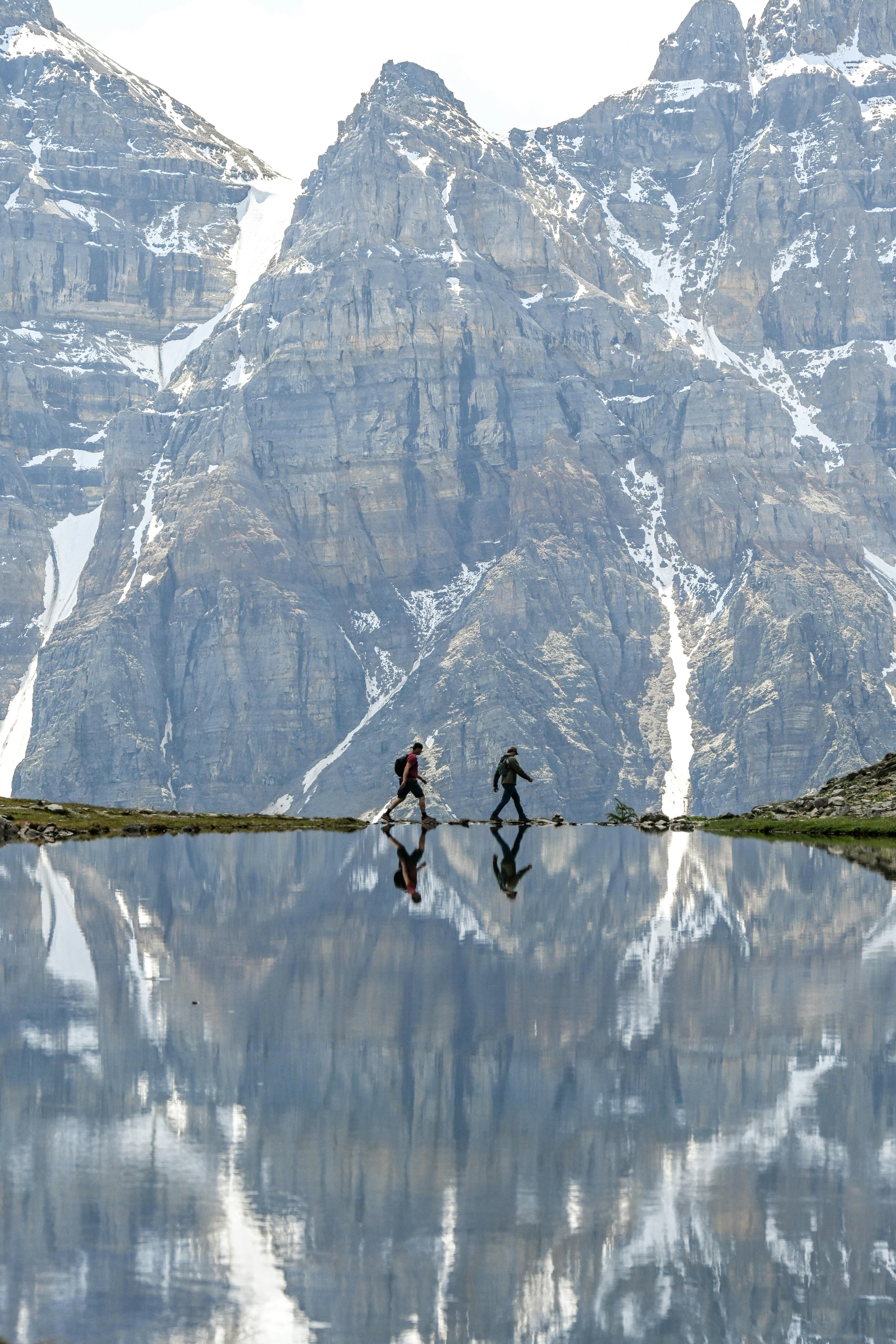
 Photo · Mary Brennan
Your first trip to Banff
Park passes, reservations, tipping, parking, altitude — the operational details that separate a smooth first trip from a frustrating one. This guide covers them so your first day isn't spent figuring them out.
Most first-time visitors arrive in Banff with two assumptions: that it will feel like a wilderness retreat, and that the practical details can be sorted on arrival. The first is true on a Wednesday in April. It is not true on a Saturday in July, when the town's population temporarily quadruples and finding a parking spot becomes nearly impossible.
What follows is a practical reference covering the questions visitors ask most often — the unglamorous logistics that shape whether a first day runs cleanly or gets eaten by guesswork. Bookmark it, share it with anyone travelling with you, and skim the headings if you're short on time.
You'll need a Parks Canada pass. Buy it before you arrive.
Banff is located inside Banff National Park, so if you're stopping anywhere in the park — including the Town of Banff, Lake Louise, trailheads, viewpoints, or your hotel — you'll need a valid Parks Canada Day Pass or Discovery Pass. The only exception is driving straight through the park without stopping, in which case you can use the bypass lane at the Banff East Gate.
A Day Pass costs $12.25 CAD per adult, while the Discovery Pass costs $83.50 CAD per adult and gives you unlimited entry to more than 100 Parks Canada destinations for 12 months. If you're spending several days in the Rockies — or planning to visit places like Yoho, Jasper, or Kootenay — the Discovery Pass is usually the better value.
You can buy your pass online before your trip, at the park gates, or at the Banff Visitor Centre. Buying ahead can help you avoid waiting at the entrance during busy summer periods, when gate lineups can become lengthy.
Make restaurant reservations. Yesterday, ideally.
This is the single detail first-time visitors most consistently underestimate. Banff has roughly 80 restaurants serving a town that swells to 25,000+ people on a busy weekend. Walk-ins after 6 PM in summer are a coin flip at best. The well-regarded venues — and most of the well-known ones — are booked solid two to three weeks out.
The practical approach: identify three or four restaurants you want to try, reserve them as soon as flights are confirmed, and treat them as fixed points in the itinerary. Build the day around the dinner reservation, not the other way around.
Winter is the reverse problem.From October to April tables are easy to get, but kitchens close early — many at 9 PM, some at 8 on weeknights. Book dinner for 6:30 or 7, not 8:30, and don't expect to walk in and order at 9:15. If you're coming off the hill late, the late-night kitchens list in the Banff After Dark guide is the one to have open.
Lunch is more forgiving — most venues take walk-ins until about 1:30 PM — but if a specific restaurant is non-negotiable, book ahead. Banff Advisor's restaurant directory notes which spots accept reservations and which are walk-in only, alongside current happy hour and special menus.
Tipping in Canada: 18% is the floor, not the ceiling.
Visitors from regions with different tipping conventions — Europe, Australia, much of Asia — should note that service staff in Banff earn the standard Alberta minimum wage and depend on tips as a meaningful portion of their income. The expected range:
- →Restaurants: 18–20% of the pre-tax bill. 15% is increasingly read as a quiet complaint about service.
- →Bars and pubs: $1–2 per drink, or 18–20% of the tab.
- →Taxis: 10–15%, rounded up. (There are no ride-shares here — see below.)
- →Hotel housekeeping: $2–5 per night, left on the pillow on the last day of the stay.
- →Tour guides and instructors: 10–15% of the tour cost is generous and well received.
Most card terminals will prompt with tip percentages, defaulting to 18%, 20%, and 22%. If service was genuinely poor, 10% paired with a quiet word to a manager is appropriate; tipping nothing is not. GST (5%) appears separately on the bill, and tip is calculated before tax.
Parking is the hardest part of a Banff day.
Parking is the single biggest source of visitor frustration in Banff. Here's what you need to know:
- →Downtown parking fills early. On summer weekends (late June through early September), the most convenient Banff Avenue lots are often full by 9:30–10:00 AM. Don't expect to drive straight into the town centre and find a spot.
- →Use the free peripheral lots. Park at the Train Station Public Parking Lot or Fenlands Recreation Centre, then take the 10–15 minute walk into town or hop on the free Roam Transit shuttle (Route 7).
- →Don't plan on driving to Moraine Lake. Personal vehicles haven't been permitted on Moraine Lake Road since 2023. The Parks Canada Shuttle, a connection from Lake Louise, or a commercial shuttle are the easiest ways to visit.
- →Lake Louise parking fills before sunrise. In summer the lakeshore lot is often full by 5–7 AM. Unless you're arriving very early, plan to use the Parks Canada or Roam Transit (Route 8X) shuttle instead.
- →Johnston Canyon parking is extremely limited. You can still drive there, but the lot often fills early during peak season. Arriving early or taking Roam Transit (Route 9) is usually less stressful.
If you're staying in Banff, consider leaving the car at your hotel. The town centre is compact — most restaurants, shops and attractions are within a 10–15 minute walk — and Roam Transitmakes it easy to reach many of the area's most popular destinations.
The altitude is real, but mild.
Banff townsite sits at 1,383 m (4,537 ft); Lake Louise is at 1,750 m; Sulphur Mountain summit reaches 2,281 m. That is high enough that most first-time visitors notice a mild headache, fatigue, or shortness of breath on the first day — particularly when arriving from sea level.
Drink twice the water you normally would. Go easy on alcohol on day one, tempting as the patio cocktails are. Schedule strenuous hikes for day two or three.
Pack for four seasons. In one day. In July.
Banff weather can swing 20°C between sunrise and afternoon, and a clear morning at the lakes can become a snow squall by 2 PM. Layering is non-negotiable. A baseline packing list, even in summer:
- → A real waterproof shell — not a windbreaker, an actual rain jacket.
- → A warm mid-layer (fleece or light puffy).
- → Long pants suitable for hiking. Jeans get heavy when wet.
- → Closed-toe shoes with grip. Sandals are fine in town and useless on trails.
- → Sunglasses and high-SPF sunscreen. UV is intense at altitude, including under cloud cover.
- → A reusable water bottle. The tap water is glacier-fed and excellent.
- → Bear Spray (approx. $50) is your only line of defence here in the Park. Can't fly with it - can be bought downtown or on Facebook Marketplace
Wildlife: keep your distance, keep your food locked.
Elk in the townsite are common. Bears are routinely visible from the road. Both are wild animals capable of seriously injuring people — elk can charge and trample, particularly cows with calves in spring and bulls during the fall rut. Grizzly attacks in the park are rare but do occur; a couple was killed by a grizzly in Banff National Park in 2023.
Parks Canada's rule is 30 metres from elk and deer, 100 metres from bears and other large predators. That is further than most people estimate. Use the zoom on your smart-phone, not your legs. (You may end up getting roasted online if you do.) Better yet, buy that camera you've been putting off - this is one of the most picturesque places on earth!
Never store food in a tent or unlocked vehicle. Fines for "wildlife attractant" violations reach $25,000, and bears that become habituated to human food are typically the ones ultimately euthanized. Use the bear-proof bins and food-storage lockers at every campground.
The local etiquette nobody tells you.
- → Yield to hikers moving uphill on narrow trails.
- → Do not stop in the middle of the road to photograph wildlife.
- → Give our wildlife some space. If you are lucky enough to encounter them, observe from a distance.
- → “Sorry” is the default response to almost any incidental contact. A brushed shoulder in a busy bar earns a “sorry” from both parties. Everyone moves on.
- → Tip the bartender on the first round. Subsequent rounds tend to arrive faster.
- → The Bow River is glacier-fed and runs around 6°C in July. The current can swell and move quickly with little warning. Do not jump the fence at Bow Falls, and do not attempt to canoe or kayak past it.
"The mountains will be here. Slow down on day one."
The biggest mistake first-time visitors make isn't logistical — it's attempting to cover Lake Louise, Moraine Lake, the Banff Gondola, Cave & Basin, dinner reservations, and a soak at the Hot Springs in a single day. Pick two. Walk Banff Avenue at golden hour. Have an unhurried dinner. Come back tomorrow.
See what's on while you're here.
Live music, happy hours, special menus and limited events — updated daily by the venues themselves.